Menu


The TCC Loyalty Monitor reveals, for the first time, how shopper loyalty sentiment varies between markets. At first glance, loyalty looks reassuring, with 57% of shoppers describing themselves as very or extremely loyal to their primary retailer.
But look closer at a national level, and a very different story emerges.
The TCC Loyalty Rating, a global measure of the balance between strong and weak loyalty, shows a 75-point gap between the best and the worst performing markets. Such variation reflects fundamentally different loyalty landscapes.
.png) When you look closely at what separates the strongest markets from the weakest, the contrast becomes clearer. Lower-performing markets are often highly digital, highly competitive and heavily focused on price-led loyalty mechanics. Stronger markets tend to place greater emotional value on food, shopping and mealtimes, alongside rewards that feel meaningful rather than merely monetary.
When you look closely at what separates the strongest markets from the weakest, the contrast becomes clearer. Lower-performing markets are often highly digital, highly competitive and heavily focused on price-led loyalty mechanics. Stronger markets tend to place greater emotional value on food, shopping and mealtimes, alongside rewards that feel meaningful rather than merely monetary.
In weaker markets, shoppers participate. They sign up, scan and collect. But they don't commit. And when loyalty is conditional, switching becomes easy.
Highly connected markets can intensify that behavior. Shoppers hold multiple memberships at once, compare offers in real time and move freely between retailers. Loyalty apps and gamification can capture attention, but attention shouldn’t be mistaken for attachment.
Taiwan is home to some of the region’s most innovative loyalty programmes, seamlessly integrating payments, points, personalised offers and gamified promotions into always-on digital experiences.
With such a high standard set across the market, shoppers have come to expect frictionless, value-driven engagement as the norm. This has led to very high levels of participation, although loyalty tends to be more fluid, with shoppers open to multiple retailers rather than committing to just one (loyalty rating: -32).
In a highly connected, urban environment where switching is easy and offers are abundant, shoppers naturally make rational, value-led choices. This creates a distinctive dynamic: while engagement is strong, there is an emerging opportunity for retailers to differentiate further by building stronger emotional connections and brand affinity.
Taiwan offers a compelling view into the evolution of mature digital markets, where the next frontier of loyalty lies in moving beyond participation to becoming truly top of mind.
Australia (-11.2) and the UK (-5) reflect a different version of the same challenge. In both markets, loyalty has become closely tied to savings through member pricing, points, coupons and short-term discounts.
In Australia, loyalty primarily focuses on points collection, and price discounts, Flybuys (Coles) and Everyday Rewards (Woolworths), allow shoppers to collect points for every dollar spent, often across multiple retailers, within grocery and beyond. But in a market where the business of retail is becoming increasingly pressured, price consciousness is creating fertile ground for discounters such as Aldi to gain share.
In the UK, the “big four” remain locked in constant competition with discounters, increasingly using loyalty-linked pricing to compete. Tesco Clubcard has over 24 million household sign-ups – an extraordinary achievement – but when the primary mechanic is price, participation and loyalty are not the same thing. The result, in both markets, is high activity but weaker attachment.
The US sits slightly above the global average with a Loyalty Rating of +14.6, and in the context of its market, that is a notable result. No other market scored as close to the global average, putting the US as the only middle performer according to the responses.
American shoppers hold more than 15 loyalty memberships on average. The market is vast, fragmented and intensely competitive, with culture and shopping behavior varying dramatically between rural and metropolitan areas. Sign-ups are easy. Exclusive commitment is rare.
What keeps the US in positive territory is innovation. American retailers are among the most advanced in the world when it comes to digital engagement, using apps and gamification to extend the relationship beyond the checkout. United Supermarkets 28 Day Challenge – now in its third year and delivered in partnership with TCC Global – is a good example: it ties loyalty to health goals and New Year motivation, rewarding shoppers in ways that feel personally relevant rather than purely transactional.
This points to something important. Digital engagement, when used to create genuine experiences rather than just distribute discounts, can build meaningful connections even in a fragmented market.
Despite sophisticated engagement strategies, switching remains high, with many shoppers still willing to move for a better offer elsewhere and loyalty remains fragile – and that makes it an interesting bridge between the weaker markets and the strongest European performers.
The strongest markets – France (+43), Germany (+27), Spain (+23.8) and Italy (+22) – offer a different model entirely. And among them, two themes appear consistently.
The first is food culture. In these markets, grocery shopping is not a transaction to be optimized. It is part of daily life, family routine and cultural identity. Food matters. Mealtimes matter. The act of shopping carries meaning that extends well beyond price. Retailers have earned their place in that culture – standing for quality, provenance and experience – and shoppers feel a genuine connection as a result. That connection is not easily disrupted by a cheaper alternative.
The second is how rewards are structured. In stronger markets, loyalty mechanics tend to be simple, tangible and generous. Shoppers meet a spend threshold and receive something of real value in return – quality cookware, collectibles, experiences. No points calculations, no marginal discounts. Just a clear, uncomplicated thank you for loyal behavior. In many cases, this extends beyond the individual, with rewards that enable shoppers to give back to their communities, supporting local causes such as schools and sports teams. This transforms loyalty from a personal transaction into a shared purpose.
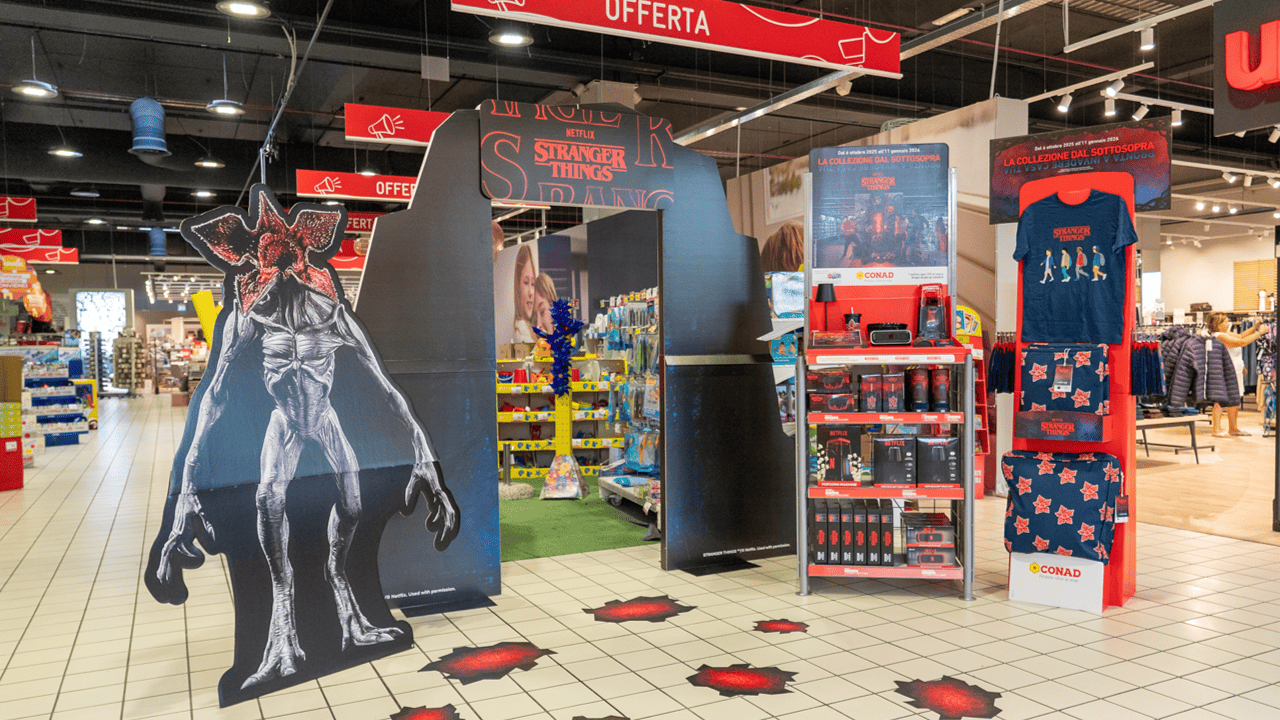
Conad’s Stranger Things campaign in Italy, delivered by TCC Global in partnership with Netflix, shows what this can look like at its best. Shoppers could collect exclusive merchandise, experience in-store activations, and extend that engagement into Netflix’s fully built Stranger Things experience at the Lucca Comics convention. 69% of surveyed shoppers made Conad their main store during the campaign. That is not a promotion. That is a shared cultural moment and a powerful demonstration of what loyalty looks like when it moves beyond price.
 What the global view tells us about loyalty
The TCC Loyalty Monitor provides a truly global view of how loyalty is felt, and how it differs between markets. It highlights clear variations between countries, showing that no single factor determines how loyal shoppers feel.
Cultural and socioeconomic context plays a significant role. In some markets, such as Taiwan, structural factors like digital saturation and ease of switching create real headwinds that even the most innovative retailers struggle to overcome. In others, including Australia, trust and price credibility have a stronger influence.
But these differences are not fixed. The US shows how innovation, particularly through digital engagement and experience-led rewards, can drive participation and maintain positive loyalty even in a fragmented, highly competitive landscape.
Ultimately, the strongest results come back to fundamentals. Markets where retailers create a clear sense of value, trust and emotional connection achieve the highest Loyalty Monitor Ratings.
By combining these principles with innovation, there is an opportunity for every market to strengthen loyalty – not just in behaviour, but in how it is genuinely felt.